Showing posts with label 2011-12 budget. Show all posts

Saturday, June 30, 2012

There's a hole in his pocket, dear Liza , dear Liza

Uh..oh....it happened AGAIN!
The district got caught spending (what used to be) 2011-12 surplus funds on equipment that SHOULD have come out of the 2012-13 budget.

This time we "over-spent" the budget by about $200K, bringing the total of hoovered surplus funds to $500K. Word is that it was for computers next fall.


Budget line #560, EQUIPMENT_REPLACEMENT
2011-12 May 2011-12 2011-12 FYTD
REVISED Activity Total Encumbered Unencumbered
Budget 2011-12 Spent Amount Balance
213,548 13,721 203,934 197,274 -187,660
That there negative balance means that we've exceeded the budget by $188K.
The encumbered amount, $197K, is what suddenly got spent once somebody knew there was a surplus.  You know...let's bend that surplus like Beckham before we have to give it back to the taxpayers??
 Doesn't $200K have to go through the school board? Be bid?

C'MON PEOPLE!

Sunday, June 3, 2012

Losing confidence in Sun Prairie School District


Sadly, the credibility of the district is going up in flames, ignited by the sparks of a lengthening track record of poor quality information and financial freewheelin'.

The question we have is: how can we have any confidence in the fiscal management of the Sun Prairie Area School District?

Most recently we have the district exceeding the 2011-12 budget for certain line items and using 2011-12 surplus dollars to purchase items required for 2012-13 school year.  Without any public discussion. Or approval from the school board.

We also find out that the brand spanking new JV baseball field has drainage issues that is budgeted to cost $70,000 to repair.  Is this not something that should have been identified earlier and made the responsibility of the contractor that graded the field?

The Ashley field costing has blown credibility to shreds.  We were told that annual maintenance costs are $60,000 countless times.  Then late in 2010, the district re-calculated maintenance costs at only $15,000 per year.  However that figure has not been widely released.  Why?  Because the initial plan assumed that we'd save at least $450,000 in maintenance costs over 120 years, and therefor the district should pony up at least $450K.

And that's just this year.
Go back to last year and we have the whole candy fiasco, the inaccurate data coming out of the business office, the shenanigans which occurred at the annual meeting to name just the major hitters.

The *new* budget timeline works for the district but not for the community
This year we have heard no official word at all about the budget, and that's bad for the community.  The first time we officially see any form of a real budget, the new fiscal year will already have begun.
Seriously...how wrong is that?
That's like getting your tax bill after it's due.
Like getting your position description after you start a job.

We've gone backwards, people.
We should be reviewing the state of the CURRENT budget with the community from March through June, as the school and fiscal year year ends.
At the same time, we should be reviewing plans for spending for the upcoming year.


Mid-year budget changes are (almost) entirely unacceptable
With the exception of an unexpected grant or some major unanticipated cost, we should NEVER bee changing the budgeted amount for a given budget line.
Administrators get paid the big bucks to know how to budget...accurately.
And, if we DO need to exceed the budget, isn't that what fund balance is for?
Stop trying to con us into believing that leaving fund balance alone is required to get  a good rating and good interest rates. Poppycock.  That's the stuff that Walker feeds us.  Do we really want it from the district?

The complexion of the board has changed significantly.
We have a new board president.
This is a window of opportunity
for a board  with a new majority
We have a new board treasurer.
It's time to change the way the Sun Prairie Area School District does business.
But it starts with the board; it must take action to address and correct the issues.
And that action begins with a Situation Report and a public discussion.
Any volunteers?

Monday, May 28, 2012

Budget surplus looks like a safer bet than June 5 outcome

To be fair, SPASD budget guru Phil Frei has been saying that there will be a surplus at the end of this June.  On that point we agree.  It's the dollar amount where our paths diverge.

The stock market has all kinds of indices on which performance is evaluated.  We need and index for the 9 budget focal points we monitor.  Let's call it the SP-NEYEN.

We believe that these budget lines are representative lines where the district habitually over-budgets.  They serve as nine socks of money.

Let's all be like the giving tree, eh?
At the end of March, we were projecting a surplus of $635 K just from these 9 budget lines alone.  At the end of April, we see the surplus as having grown to just over $700K.  And think about it.  Gas for Heating is virtually done for the calendar year.    83% of the school year is in the books, and we;'ve spent only 2/3 of the budgeted amount.  And the two remaining months require very little heating.   Similarly for electricity, we have $348K budgeted dollars remaining, and --on average-- we spend $96K per month.  Anyway you slice it, we have at least $150K surplus in that line item alone.

So why has Phil Frei repeatedly said that he anticipates a surplus of only $200-300K?   What does he know that he's not sharing?  Remember the giving tree?  Can't we all be like the giving tree?   Shouldn't the district be sharing information so the public can understand the budget? Sharing is caring, right?

Or does the district simply prefer to treat community residents like mushrooms.

Sunday, May 6, 2012

Crystal Ball: Doesn't Take A Genius to See a Surplus

The only question, then, is.... how much?

We've heard estimates of $200-$400K surplus for the school year from the district office.
What has not been clear is whether that projected surplus considers the $350-$700K planned to be used from fund balance this year.  Or is that $200-400K over and above (meaning we would actually INCREASE rather than decrease fund balance)?

All good questions for which we currently lack answers.
And since the district is showing very few of its cards regarding the 2012-13 budget, let's just shake the trees a bit and see what falls out, shall we?

We looked at just NINE budget "lines", and we see approximately $635K of surplus just from those lines alone.  Of course their could be some hefty shortages in some budget lines of which we have not been forewarned.  But let's just focus on what we can (and you should too) see in just 9 simple budget lines.

1. Line 331 Gas for Heat
Through March (75% of the fiscal year) only 61% of budget had been spent.  14% unspent after 3/4 of the year is complete would suggest that we might logically end up as much as 18.7% under budget.   18.7% of a $305,518 budget would translate to a surplus of $57,000.

Looking at it another way, $120K of the budget remains unspent.  Last year, Gas expenses for April through June were $57K.  This year, we have averaged $23K per month.  Based on this year's spending trend, we could project spending about $69K.  That tells us that we can project a surplus of $51-$61K.  Compare that to our earlier projection, and it seems realistic to expect about $60K surplus.


2. Line 337 Water
Through March (75% of the fiscal year) only 51% of budget had been spent.  24% unspent after 3/4 of the year is complete would suggest that we might logically end up as much as 32% under budget.   32% of a $55,030 budget would translate to a surplus of $17,600.

Looking at it another way, $27K of the budget remains unspent.  Last year, expenses for April through June were $10K.  This year, we have averaged $3,500 per month.  Based on this year's spending trend, we could project spending about another $10.5K.  That tells us that we can project a surplus of $17K.  Compare that to our earlier projection, and it seems realistic to expect about $17K surplus.


3. Line 336 Electricity
Through March (75% of the fiscal year) only 63% of budget had been spent.  12% unspent after 3/4 of the year is complete would suggest that we might logically end up as much as 16% under budget.   16% of a $1,209,019 budget would translate to a surplus of $193,443.

Looking at it another way, $452K of the budget remains unspent.  Last year, expenses for April through June were $295K.  This year, we have averaged $95K per month.  Based on this year's spending trend, we could project spending about another $285K.  That tells us that we can project a surplus of $157-167K.  Compare that to our earlier projection, and it seems realistic to expect about $160K surplus.


4. Line 411 Supplies
Through March (75% of the fiscal year) only 57% of budget had been spent.  18% unspent after 3/4 of the year is complete would suggest that we might logically end up as much as 24% under budget.   24% of a $1,101,715 budget would translate to a surplus of $264,411.  Note that with the March budget adjustments, this line was LOWERED by $56K!  This however, is a line that gets spent down heavily in the last few months.  Hmmmm.

Looking at it another way, $331K of the budget remains unspent.  Last year, expenses for April through June were $248K.  This year, we have averaged $76K per month.  Based on this year's spending trend, we could project spending about another $228K.  That tells us that we can project a surplus of $83-103K.
Compare that to our earlier projection, and it seems realistic to expect at least $80K surplus.


5. Line 490 Other Non-Capital Objects
Through March (75% of the fiscal year) only 16% of budget had been spent (Nope, not a typo...16% spent to-date).  84% unspent after 3/4 of the year is complete would suggest that we might logically end up as much as 89% under budget.   89% of a $81,150 budget would translate to a surplus of $72K.  Note that with the March budget adjustments, this line was INCREASED by $7K!  Why on earth would we budget MORE for a budget line that has only spent 16% of its total budget to-date?  Hmmmm.

Looking at it another way, $58K of the budget remains unspent.  Last year, expenses for April through June were $10K.  This year, we have averaged $1,500 per month.  Based on this year's spending trend, we could project spending about another $3.5K.  That tells us that we can project a surplus of $48-55K.
Compare that to our earlier projection, and it seems realistic to expect at least $50K surplus.

6. Line 109 Substitutes (Teachers)
Through March (75% of the fiscal year) only 57% of budget had been spent.  18% unspent after 3/4 of the year is complete would suggest that we might logically end up as much as 24% under budget.   18% of a $1,157,033 budget would translate to a surplus of $268K.  Note that with the March budget adjustments, this line was DECREASED by $100K!  Hmmmm.  Seems like someone saw what we see.  But, the trend is for a much higher substitute cost in the spring.  Teachers playing hooky when the weather gets nice?

Looking at it another way, $496K of the budget remains unspent.  Last year, expenses for April through June were $391K.  This year, we have averaged $73K per month.  Based on this year's spending trend, we could project spending about another $220K.  That tells us that we can project a surplus of $105-276K.
Compare that to our earlier projection, and it seems realistic to expect at least $100K surplus.


7. Line 310 Personal Services (Send Lawyers, Guns and Money)
Through March (75% of the fiscal year) only 59% of budget had been spent.  16% unspent after 3/4 of the year is complete would suggest that we might logically end up as much as 21% under budget.   21% of a $1,109,139 budget would translate to a surplus of $233K.  Note that with the March budget adjustments, this line was INcreased by $1,100!  Ummm...what's the point of raising a $1.1M budget by $1,100?Hmmmm.

Looking at it another way, $378K of the budget remains unspent.  Last year, expenses for April through June totaled $321K.  This year, we have averaged $72K per month.  Based on this year's spending trend, we could project spending about another $216K.  That tells us that we can project a surplus of $57-162K.
Compare that to our earlier projection, and it seems realistic to expect at least $55K surplus.  Even if we expel all 6 of the pot brownie boys. :-)


8. Line 342 Employee Travel
Through March (75% of the fiscal year) only 52% of budget had been spent.  23% unspent after 3/4 of the year is complete would suggest that we might logically end up as much as 30% under budget.   30% of a $80,151 budget would translate to a surplus of $24K.  Note that with the March budget adjustments, this line was DEcreased by $3,600.  

Looking at it another way, $40K of the budget remains unspent.  Last year, expenses for April through June totaled $12K.  This year, we have averaged $5K per month.  Based on this year's spending trend, we could project spending about another $15K.  That tells us that we can project a surplus of $25-28K.
Compare that to our earlier projection, and it seems realistic to expect at least $25K surplus. 


9. Line 940 Dues & Fees
Through March (75% of the fiscal year) only 53% of budget had been spent.  22% unspent after 3/4 of the year is complete would suggest that we might logically end up as much as 29% under budget.   29% of a $338,349 budget would translate to a surplus of $98K.  Note that with the March budget adjustments, this line was DEcreased by $8,500.  

Looking at it another way, $148K of the budget remains unspent.  Last year, expenses for April through June totaled $41K.  This year, we have averaged $20K per month.  Based on this year's spending trend, we could project spending about another $60K.  That tells us that we can project a surplus of $88-107K.
Compare that to our earlier projection, and it seems realistic to expect at least $88K surplus. 


Y'all do the math.  See if you see differently.  Now...the district could, of course, suddenly accelerate its spending in these lines, or magically transfer the overages to other budget lines.  The bottom line is that over-budgeting is the oldest trick in the books to increase fund balance. Oh, gee....we over spent?  No...no...you have it all wrong...we were just being frugal.  Guess we'll just have to put the surplus into fund balance.


Sunday, March 18, 2012

Changing The Budget Like the Weather

budget [ˈbʌdʒɪt]  n
(Economics, Accounting & Finance / Accounting & Book-keeping) the total amount of money allocated for a specific purpose during a specified period.
---FreeDictionary.com

Budgeting is the setting and allocation of the capital which is then used in the proper way to achieve the set or designated targets of the firm. 
---Budget (Wikipedia)

The purpose of a budget is to establish spending limits on various functionalities (e.g., utilities, rent, salaries).  The idea of course, is to stay within one's budget.  Hmmmm.  Sounds simple enough.  You establish  a budget and then limit your spending to stay within your budget.

Or....you can ride on the SPASD Funds Rollercoaster and just change the budget amount every month!
Whoa...say WHAT?

When the rest of us establish a budget for our homes, we do not adjust our budget based on the bills that come in each month.  That defeats the purpose...right?

So...why is the school district changing the budgeted amount for these five (and others) budget lines on a monthly basis?
Why would you do that?

Certainly, the big changes made in October  reflect the "final" budget following the annual meeting.  We find it interesting, though, that as a result of the annual meeting, approximately $600K of additional spending was authorized, largely on diversity and Response to Intervention (RTI) activities.  How on earth does that translate to the huge increases we see here?  What other reasons are there to explain it?

And why even bother making such minor changes as we see here? Between August and September, the budget line for OTHER NON-CAPITAL OBJECTS (490) was reduced by exactly $112.  $112!!!!  What Non-Capital object costing $112 did we suddenly decide not to buy?

With the exception of General Supplies (line 411) each of these other 4 lines saw budget changes amounting to less than 1% of the entire budget!  Putting it into every day perspective, that's like a household which averages $100/month on its electric bill, or $1200/year budget, suddenly adjusting its annual budget to $1188.   Why would you even do that?

We GET that the district makes (and the school board approves) quarterly budget adjustments.  It may make sense to make minor coarse adjustments along the way...but EVERY month????

Move it over dad 'cause I'm a double-dipper!
Upside down on the zip-zip-zipper
1,2,1,2,3, I′ve got a ticket so ride with me
Mary go down on the merry-go-round
All is fair on the fair ground
Funds go slow, Funds go fast
These budget twists gonna whip your ass.

----Red Hot Chili Peppers (and the Ohio Players) -Love Rollercoaster

Sprechen Sie Budget?

It is long overdue, folks.
We're in the midst of March Madness (weather-wise as well as basketball-wise).
Dontcha think we should be talking budget?
We may hear something at the next Finance Committee meeting.
But just to whet your appetites....and to perhaps to initiate an incendiary flare beneath district administration's derrieres....we offer you an in-depth budget analysis of just ONE budget line.

Our forecast calls for....surplus...and a surplus of it.
Nope...nothing new here.  That's pretty typical.

Let's just focus on electricity (line 337) ...shall we?
That's an easy one...right?
In fairness, let's begin by saying that the original budget (July 2011) was for $1.261M and it was subsequently reduced to $1.209M in August.


  • For FY2010-11, there was a budget line surplus of $194K (15.5% of total budget) 
  • For FY2011-12, this line budget has been DEcreased by 3% ($43 K) 
  • So…despite a $194K surplus last year, we only DEcreased the budget by $43K? 
  • With 58% of the year in, we have spent only 32.6% of this budget line …
  • ...and in FY 2010-11, the last 5 months of the year accounted for 47% of spending

 We're budgeting $101,000/month, yet only spending $93,000/month.
That alone suggests a surplus of at least $96,000.

For the remaining 5 months of the year, we have $651,000 budgeted for electricity usage.
At a budgeted rate of $101K/month, that would indicate a surplus of $146,000.

Looking at actual expenditures to-date and even using last year's real costs from February through June, a surplus of $157,000 is anticipated.

Three different ways to analyze it, and we see projected surpluses of $96,000- $157,000.

Anyway you slice it, we have significant surplus in just this one budget line item.

Now that we've outed it, anyone wanna bet that the budget for this line item gets adjusted downward and the "surplus" sprinkled throughout a ton of other budget lines as part of the "March Budget Adjustments"?

Saturday, March 3, 2012

Surplus with a Purpose?

Since the district isn't uttering a peep regarding the status of the 2011-12 budget or potential ramifications of the FY2012-13 budget, we will.  We were reviewing the current " EXPENDITURE SUMMARY REPORT BY OBJECT ".
(click to enlarge)

 Let's start with the low hanging fruit.  Unless you've spent the last 4-5 months working on your tan in Florida, then it should come as no big news to you that we've had a pretty mild winter.  And with a mild winter comes huge "savings"...or, as some district folks like to phrase it, "cost avoidances".

Little snow (okay except for yesterday) means little need for snow removal costs.
Warmer temperatures means for less need for building heat.
Milder temperatures also mean less electricity use what with the thermostat not going on and off.
Actually, we looked at the heating degree days data for the winter, and learned that going back to October, the Madison area is running 18% LOWER than the average year.  And when you realize that the school district budget based its budget off of last year's budget (where we had a surplus) and then ADDED 5%, then there's room for a pretty heft budget surplus AGAIN this year.

The pants of this budget are so loose,
we haven't seen this much crack
since the refrigerator guy was here
Like Caren Diedrich, we understood that this budget was so tight that it squeaked.  Actually, it's  looking like this budget's so loose, it's pants are gonna drop.  You've seen it...and you know it's not attractive.

More to the point, once again, it appears that we budgeted WAY more than necessary.  Your tax dollars at work.  Any guess as to what little projects the district will be seeking to fund with your unnecessary tax dollars?  Let's look at the projected surplus from just 3 budget lines.

Substitute Teacher Salaries
The budgeted amount was $1.25M for the entire school year.  Given that school is only in session 10 months, that comes to about $125,000 per month.  In January, we spent $86,000.  Having only spent $440,000 year-to-date (~$85,000/mo), that leaves us with a budget balance of $810,000 for the remaining 3.5 months of the school year.  Unless a whole boatload of teachers are planning on attending week-long conferences, we should EASILY have $250,000 to $350,000 leftover--if not more.

Gas for Heating
(click to enlarge)
The budgeted amount was $305K for the entire school year.  Given heating is usually mainly needed in October through April , that comes to about $50,000 per month.  In January, we spent roughly $40,000.

Having only spent $100,000 year-to-date (~$25,000/mo), that leaves us with a budget balance of $205,000 for the remaining 2.5 heating months of the school year.  And those would be warmer months in an already warmer than average year.  Unless the arctic slides south a few thousand miles, we should EASILY have $80,000 to $100,000 leftover----and likely more.

Electricity
The budgeted amount was $1.2M for the entire school year.  That comes to about $100,000 per month--on average---and we know that costs are heavier from September through June.  In January, we spent $93,000.  Having only spent $560,000 year-to-date, that leaves us with a remaining budget balance of $650,000 for the remaining 5 months of the school year.  While we could have a VERY warm spring in store, it seems likely that we will have over-budgeted by $100,000 to $150,000.

Combined Projected Surplus
From just three budget lines, mind, you....we see what appears to be somewhere between $400,000 and $600,000.

Stay tuned as we peer into other parts of the budget.


Sunday, October 30, 2011

School Board Chooses Wisdom...and Compromise

On Monday night, the school board had to make a choice:
...set the tax levy $267,000 higher than proposed based on the voice of the faux "electors".
...or to stick to their guns and Caren Diedrich's line in the sand of a tax levy increase not to exceed 3.5%.

They chose wisely.
And they opted for compromise.
Amidst a little detour from decorum on the part of board president John Whalen.

The faux "electors" voted a tax levy $267,000 higher than that in the proposed budget because they wanted to fund the "Sensational Six" new budget initiatives that the school board had ultimately decided against building into its budget.

The board chose wisely because the money WAS available in the existing budget (as we've said all along).  So the faux "electors" ultimately get what they want, district administration gets what they want, and residents struggling financially do not have to deal with a property tax greater than anticipated.

You have to respect board member John Welke for sticking to his guns and casting the lone "No" vote.   The original motion coming out of the Finance Committee called for a levy of no more than 3.5% and to fund only the top 4 initiatives.  The district simply did not do an adequate job in explaining the need for the Buildings & Grounds FTE or the Data Programmer.  It's hard to put oneself out on a limb; but anyone can be a sheep.

Everybody wins.

Now, the next task at hand is to repair the damage done and fix the annual meeting process.
What is the point of having ANY budget hearings during the years.  Why not wait until one week before the tax levy is required to be set by law, come out in force at the annual meeting and vote in a tax levy right up to the revenue limit.

Hey...why not just vote a tax levy $2.6M higher, and take us right up to the revenue limit this year.  Then we could simply send any kid that wishes to learn Mandarin Chinese over to China for a year...all expenses paid.  Heck we could send a bunch of administrators as well.

After all, taxing right up to the revenue limit would only add about $0.70 (70 cents) to the mill rate.  For a $200,000 home, that's only about another $140 per year, or about $12 per month.

Isn't it worth sending kids directly to China for a year to lean Chinese at a cost of only a large pizza per month?
Who cares if it would raise the mill raise higher than it has been since 1996-97 ($13.65)?
Right????

Sunday, October 16, 2011

October 17th: Rubber Match?

In 2009, district residents attended the school district's Annual Elector's Meeting in force, voting by a 2:1 margin to reduce the proposed tax levy by $2,000,000. And yet the district ended up with a SURPLUS of $1.3 MILLION DOLLARS!  Can you say, "budget fluff"?

Last year, the district appeared to have learned its lesson and reduced its demands.  Just in case, the district teachers and their significant others attended the meeting in force to ensure that the proposed levy passed.  And it did.

So...what will happen this year?  Will district residents believe "you can't fight city hall" and not show up?  And if not....if residents again attend en masse, will the teachers have the district's back this year?  Or, in anticipation of potential "work rule" and "compensation plan" changes to come, will they turn their backs?  Governor Walker and his infamous Act 10 have completely jumbled the puzzle pieces.

Tomorrow is your chance to speak your piece, residents.  Speak now, or forever hold it.  Well...at least until next year, anyway.  Is a 3.5% tax levy justified?  It's your call....but only if you attend the meeting.


All Community Members Qualified Electors 
of the Sun Prairie Area School District are Encouraged
to Attend the Annual Meeting This Monday
October 17, 2011 at 7:00 pm
Performing Arts Center, Sun Prairie High School

Waunakee Enrollment Lower Than Projected--Board Reduces Levy

Waunakee enrollment 26 less than projected; levy reduced $173K

Source: Waunakee Tribune 10-5-11
After district officials already lowered their estimated tax increase to 2.1 percent earlier this month in advance of a planned refinance of the district's debt-service fund, the district is again lowering the tax burden on Waunakee property owners, this time by an additional 0.7 percent. So when property owners receive their bills, they'll see about a 1.4 percent increase in their school tax levy.

The new numbers come after the district saw less than anticipated growth in student population taken during the school's annual September head count.

In the count, taken on the third Friday of classes, Waunakee had 3,874 students reporting to classes, up 180 students from the previous year. It's fewer than the 3,900 students district officials thought would be attending class, meaning the district is losing out on $172,791 in anticipated revenue under the complex revenue cap formula.

Because the enrollment count is a direct relationship with school revenue streams - as one goes up the other does, too - a lower enrollment means districts can't raise as much money. That means districts can cut from one of two streams of income, state aid or property taxes. 


Sun Prairie enrollment 32 less than projected; residents get ...bupkis?
So...Waunakee enrollment falls 26 short of projections and they cut the tax levy all on their own. Do not hold your breath that Sun Prairie will do they same.  Why?  Because SPASD can be counted upon to squirrel money away for pet projects.  Suddenly, each spring they "find" money to do things like complete the very expensive (and far more costly than projected) remodel of the district office.

This time, they have somewhere between $200,000 and $300,000 to play with.  On top of $278K in unanticipated aid from the state.  And another believed $200K or more from open enrollments. Of course then there's miscellaneous flotsam and jetsam built into the budget which likely totals another $200K.

Full Disclosure
 Unlike the Sun Prairie school district, which will ONLY tell you things that make them look good, we provide the WHOLE story.  Consequently it should be noted that while Waunakee DID cut the tax levy in response to the lower enrollment than projected, they kind of had to.  Waunakee in the last 2 years has taken to levying right up to the revenue limit.  So...when enrollment falls shy of projections, then the revenue limit is decreased, which means the district has to cut revenues (and in turn shave spending).

If the district is already proposing to tax right up to the revenue limit, as Waunakee, then the district can either turn back (reduce) its state aid, or reduce the amount of money it proposes to tax property owners.  In Waunakee's case, since they already had taken the maximum 10% reduction in state aid, its only option was to reduce the tax levy. So really...they didn't have a choice.

What is important in all this, however, is to note that there IS a connection between projected enrollments  and spending.  A district budgets for its best guess at enrollment, and there is a general expenditure per student "formula".  If enrollment is less than projected, the district SHOULD revise its budget and spend an appropriately lower amount.  In Sun Prairie's case, the district has not taxed to the revenue limit (to their credit).   Therefore they can legally spend any "over" budgeted amount (due to enrollment) because there is "room under the [revenue] cap".

Friday, October 14, 2011

District Gets $270K More State Aid Than Expected...Likely None for the Taxpeyers

The final state aid allotments were released today.
Sun Prairie will now receive $30,805,167 (a 5.42% decrease over last year), which is $267,732 more than the estimate released July 1 ($30,537,435). That's $268,000 more to spend .... OR ... they could reduce the tax levy by that amount.

Which do you think is going to happen??

 Of course, by our calculations there's an additional $200-$300,000 over-budgeted due to 20% lower new enrollment than expected. ...and we haven't heard the final tallies on open enrollment. There's usually a reason why we DON'T hear about something.

Our estimate is that there's another $200,000 as an expense (kids transferring out) that didn't happen...which means another $200K of fluff in the budget.

Last but not least....we still see at least $300K of fluff in the other lines of the general budget. Add it all up and there's about $1,000,000 in the budget--and the tax levy---- that doesn't need to be there.

The district wants you to approve a tax levy of $47,087,483 on Monday night. 
We think there are better numbers out there. 
How about $46,887,483 (that reduces it $200,000) 
Or $46,809,483...that reduces it by the extra state aid we just received 
Or $46,787,483...that's a flat cut of $300,000 
Or $46,637,483...which reduces the tax levy increases from 3.5% to 2.5%


Monday is your meeting.  Give them everything they want...or send a message that they have more than enough and that YOU are hurting financially.

Saturday, October 8, 2011

3rd Friday Count & Its Potential Budget Impact

So....last year, district "Key Communicators" received an e-mail ---a virtual shout from the mountaintop---that enrollment increased by 338 students, well over the budget projection of 133.

This year?  The district projected 162 students over last year's 3rd Friday count, but we haven't heard diddly.  What do you suppose that means?  No news means not so good news...are we right?

10 days ago, we asked the district what the count was and were told it was around 150...between 150 and 160.  But still, no official tally has been released.

We understand that school board members were told the final tally this week, and it is 130 additional students, or 32 LESS than projected.  Great...but what does it mean?  One thing is certain...it means we're still growing...and that is a good thing for a district that likes to spend money like it's going out of style.

No additional state aid...at least for this year
The 3rd Friday count has no impact on state aid for the current school year.  State aid is based on an average count from the three prior years.   What the 3rd Friday count DOES impact for this year is the state-imposed revenue limit.  It means that the maximum amount the district can spend (total of federal & state aid plus property taxes) will be lowered.  But...since the district was already planning to spend well underneath the revenue limit, the shortfall from projected enrollment does not negatively impact the 2011-12 budget.

But less students means less costs!
This is basic economics, folks.  Less students means less cost to educate said students.  Sure, the district will be quick to say "That's not true!".  And yes, technically, whether we have 7000 or 3500 students, our "fixed" costs....building maintenance, debt levy, and most heating/cooling remain the same.   But certainly, if we had half as many students, we wouldn't need as many teachers...or administrators.  [Don't get yer undies in a bunch.  We're not advocating to cut staff.  But we are making a point.]  Beyond personnel costs, there is the cost for textbooks, copy paper, supplies...everything needed to educate students.

So...if we have less students, the means we need to buy less paper...right? Not to mention less Skittles, Ho-Hos, and B.O.S.S. subs...right?  In fact, when the district prepares its budget, it "plans" on a certain number of students.  This "projected enrollment", then, drives the rest of the budget for supplies and even personnel.
Basically, the district has a number...let's call it "x"...which represents the budgeted "cost" per student.  Therefore, with a projection of 162 new students, the district must have multiplied 162 by "x" and arrived at an amount by which the budget needs to be increased "for enrollment".  Unfortunately, they don't tell us what "x" is!

What's important is that since we have 32 less students than expected, certainly the budget can now be trimmed by 32X...right?

Solving for X
At the June 16, 2011 Public Hearing on the budget we were told that the district spends $12,345 per student.
Sun Prairie School District Math
At the July 18, 2011 Public Hearing on the budget we were told that"shared cost" per student is $10,866.
Also at the July 18th meeting, we were shown a slide that stated that a 2.3% levy increase was required just for "additional enrollment".  That allows us to do some math and determine that 2.3% of the 2010-11 budget comes to $1,046,584.   With a projection of 162 new students, that means a tax levy increase of $6,640 per new student is proposed.  Since we now know that we have 32 students less than projected, that means the tax levy c/should be lowered by at least $206,733.

Wanna bet we wont' see the school board advocating for a reduction in the levy? And certainly the district won't come forward.
 Remember Phil Frei's mantra:   
"We'll spend [any budget surplus] on something else."

Bottom Line:  Anyway you slice it....no matter which figure you use, 32 less students than planned means that the proposed tax levy could be trimmed at the annual meeting by at least $200K to $325K just due to a lower enrollment than projected! 

Saturday, October 1, 2011

The China Syndrome? Here? In Sun Prairie?

Someone PLEASE explain to us the fascination the district (or a portion thereof) has with the need for Mandarin Chinese in the curriculum!

We hear the argument, "China is the second largest country by size and most populous--and therefore the ability to speak Chinese will ultimately have value".
Right.  And property values always rise.  And 100-year storms only occur once in one hundred years.
There is also truth to the fact that in European countries, most people speak multiple languages.  True.  But in Europe, driving to another country is like driving to Chicago.  We teach French and Spanish in this country because we have neighbors to the north and south that use these languages.  If some massive tsunami managed to moved China closer, perhaps then there would be a need.

People!  The generally recognized international language in the business world remains:  ENGLISH.
Further, the United Nations has declared 6 languages to be  "official" languages, but only English and French are considered to be working languages.  The 6 languages, in alphabetical order, are:  Arabic, Chinese, English, French, Russian, Spanish.

How much is this going to cost?  And where is it budgeted?
How much will this quiet movement to develop a Chinese language program cost?  And shouldn't the decision to offer it be APPROVED before we go and spend all this money travelling and what not?  Somewhere in the 3.5% tax levy increase wethinks there is a lot of cash squirreled away to spend on these costs.  Why?  Who's in charge?  Tim Culver?  The school board?  The taxpayers?

Why are we sending all even ONE individual to China?  And what's the eventual payback?
When we started a French language program (curriculum), did we send the District Administrator and high school principal to Paris for a week?  What about for Spanish?  Trips to Barcelona? Madrid? Mexico?
And wouldn't the true value be obtained by the teachers that will actually be teaching the language and culture?  And what is China getting in return?  And what will THAT cost?

Tim Culver and Phil Frei want to know why the community distrusts them and won't call them directly when they have issues.  Here is the answer:  because people have no trust when leaders (in title) spend money frivolously and do things behind closed doors.  When the checks have been cut, it's too late for anyone to say, Hey!  Wait a minute here."

Is this just yet another passing fad?
There's some good information in the following link:
http://roomfordebate.blogs.nytimes.com/2010/02/07/will-americans-really-learn-chinese/

http://www.gocomics.com/jeffdanziger/2010/04/20

It seems clear that it is a monumental challenge for someone to learn Chinese during high school (and that's only 3 years in Sun Prairie).  All experts agree that IF one is to successfully learn one of the world's most difficult languages with its thousands of characters (the good news is that learning only about 3,000 characters is enough to get one around) and multiple intonations, it must be learned in elementary school (or befoire).  Hmmmmm...remember Culver's deep desire to establish such a program?  One can only assume that the language program --which has not been discussed publicly---will be incorporated at the high school level because we're sending high school principal Lisa Heipp to China.  But maybe that's not the plan.  Maybe she's just the lucky/special administrator that gets picked to go???

The bottom line
If this were some hoity toity private school district, by all means, you could spend the fat cat monies any way you choose.  You could develop language programs for every own language if you please.
But it's not.  This is a public, taxpayer funded school district.  And the economy is killing people that earn only a small fraction of what the Sun Prairie decision-makers are earning.  They don't feel the pain.  And their spending habits only serve to further ravage a gaping wound.

Read more about the China School Administrator Shadowing Project (in which we are obviously participating):
http://www.thechinaexchangeinitiative.org/other-projects


Sunday, September 18, 2011

Where's The Money Hidden NOW?

Realizing that the community is starting to figure things out, the district is looking for new places to stash money, which only leads to raising your property taxes higher than need be.  This money is not being used to fund educational initiatives, the district has already rejected that idea unless they are allowed to raise the tax levy increase above 3.5%.  So what will the stashed cash be used for?  Technological toys? Candy?

The latest place to focus on is the line item #382 for "Inter-district Payments".  This is largely the place where open enrollments fall.  What makes it tricky though (harder to follow) is that Open Enrollment is a double-edged sword.  One has to consider TWO budget line items:  one for revenue (students transferring INTO SPASD) and then expenses (students transferring OUT of SPASD).

How much State Aid Do We Receive/Lose Per "Open-Enrolled" Student?
There's no math here.  No figuring out cost per student or anything like that.  DPI simply sets an amount regardless of whether a student transfers in or out.

DPI Open enrollment funding memo January 2011
This year, 2011-12, open enrollment transfer amount = $6,948 (estimate) per transfer (in/out).
Last year, 2010-11, the per student open enrollment transfer amount = $6,665 (final).


What is the 2011-12 Open Enrollment Situation?
 Mar 21, 2011 - FINANCE COMMITTEE MEETING 6:30 p.m., Chair: Jim McCourt
 Subject  Action on 2011-12 Open Enrollment Applications
 Report prepared by:  Phil Frei

We're (still) a growing district
We have a brand new Taj Mah High School
Last year our net OE expenses DROPPED
...and you expect us to believe we'll have a record net OE expense?
HELP US UNDERSTAND!
HISTORY/SITUATION/RELATED ACTIONS
Each year, the District receives open enrollment applications to attend Sun Prairie Area School District (SPASD) and also to leave the District.

The District had 97 students apply to attend SPASD .  This is an increase of 21 students over last year’s applicants.
The District had 150 students applying to attend other districts.  This is an increase of 32 students from last year’s applicants.

Next year DeForest Area School District will start a 4K program.  Since many Sun Prairie Area School District children attend pre-schools in DeForest, we received many open enrollment requests out to attend 4K programming.

Typically, less than half of the students who apply for open enrollment actually attend or leave.
So....we have 97 applying to COME IN (more revenue for us) and 150 applying to leave (more EXPENSE for us).
That's a net effect of 53 students LEAVING the district... IF they all leave (and Phil Frei says that, historically, "less than half" enter/leave.
If our estimated Open Enrollment Transfer Aid per student  is $6,948 then that means we need to budget for a net  EXPENSE of $368,244 more than last year...right? But we're only budgeting $317, 567 more than last year. That makes it LOOK like we're UNDER-budgeting by $50,677
 But let's not forget the mantra we hear every year and was included in the 3-21-11 Situation Report:


 "Typically, less than half of the students who apply for open enrollment actually attend or leave."
           ----- Report to Finance Committee by Phil Frei 3-21-11


If the net effect is only half of what applications suggest, then it would seem that the net would be a loss of only 27 students, at a net additional expense (over 2010-11) of $187,596.
And THAT now makes it appear that there's a lot of extra money in the budget hidden in the open enrollment area.


...and THAT, people, would pay for nearly 8,000 hours of the RTI tutoring, which is needed so very much more than starting a Mandarin Chinese program.


The sum of the parts equals the whole.
Look at Open Enrollment Revenues
The district is budgeting $600,000 of "income " (Revenue side of the budget/line #345) an increase of about $185,000 or 27 new kids transferring into the district

Then look at the Open Enrollment Expenses
The district is budgeting $1,089,950 of "cost" (Expense side of the budget/line #382) an increase of about $317,567 or 46 new kids transferring OUT of the district

Does something smell rather fishy?
For the 2010-11 budget last year, the district budgeted for a net $482,785 OUT.  But...when all was said and done, the result (unaudited, of course) shows that our net "loss" was only $357,744.  And that means that the district had a budget surplus of $122,000 due to "over-budgeting" expenses due to open enrollment.


For the 2011-12 budget year, the district is budgeting for a net 489,950 OUT.  Last year we saw a decrease in net open enrollment cost for the first time in several years.  Suppose it had anything to do with the new high school?????  So why are we projecting a nearly half million dollar net loss when last year the amount was little more than $350,000.  Wouldn't one suppose that the trend would go the other way?
And why tell us that "less than 50% actually follow through on their transfer requests year on and year out if we're not actually using that information in our budgeting?

Monday, September 5, 2011

Time to Brace Ourselves?

Last week, the Burlington School District held their annual elector's meeting.   The district was proposing a 3.69% tax levy increase.  That levy was soundly rejected by the electors on a 153-115 vote.  Is Sun prairie next in line?  The 2011-12 budget has not even passed approval by the school boar'd Finance Committee, let alone gone to the school board for final adoption.  All signs point to the board being stuck on a 3.5% levy increase, while all over the state the majority of districts are lowering their levies.  In the interest of full disclosure (a concept alien to the SPASD top administrators) there ARE some districts out there that have gone forward with tax levy increases, some significant.

Note that SPASD will likely point to the Racine Unified School District's tax levy increase of 6.32% to make their 3.5% proposed increase look miniscule.  What they'll fail to mention, however, is that as a "unified" school district (vs. a "common" school district like Sun Prairie) is not subject to a public vote on the tax levy.

What Burlington electors got wrong
In a repeat of DeForest electors' error last year, the Burlington electors appear to have voted to reject the levy proposed by the district but did NOT vote to approve a different levy.  That is the ultimate power of the electors, but, like DeForest, they failed to use it.  That leaves the decision on the amount of tax to levy up to the school board itself.  You're not gonna love the way this one looks.
Those at the meeting voted 153 to 115 against the increase, Peter Smet, Burlington's business manager, said Tuesday. The number of people at the meeting was much, much higher than normal because the tax increase was mentioned Monday on a radio program, Smet said. "Last year there were only 35 people there," he said. "The last 10 years we've averaged about 35 people." The property tax increase would have allowed the district to collect about $725,000 more in property taxes by raising the tax rate about 3.6 percent from $9.76 per $1,000 of property value to $10.11, Smet said. 

Read about the tax levy revolt in Burlington

Saturday, August 27, 2011

That's Their Story And They're Stickin' To It

The school board met with key administrators on August 25th to review the budget and possibly take action.
The good news?  They actually reduced many of the line items we identified as being "pork infused".
The bad news?  They didn't lower the projected tax levy...not one thin dime!

While they didn't come right out and say it, the non-verbals were abundantly clear: Culver and Frei have no intention of reducing the levy --or the budget--one red cent.  And they also refuse to include any of the budget initiatives unless the school board allows them to spend more.  It's the Human Resources Specialist Part 2.  It's that whiny kid that crosses his arms and says "If I can't have it my way, I'm taking my basketball and going home."

Board member John Welke was pretty vocal that he believed there was absolutely enough money available, without adding more, to at the very least provide for district priority initiative #1: providing tutoring for kids struggling in reading and math.  Board members Weber and Camber-Davidson agreed.

As usual, McSeabass agreed that the district needs to do both initiatives 1 and 2, BUT he wanted to take the tax levy up to 3.95% (can we just call it 4%???) to do so.  Whalen jumped on that bandwagon as well.  Side note:  at one point when the figure 3.4*% was questioned regarding the currently proposed levy increase, Tim Culver smiled and indicated that administration wanted to "exceed the board's expectations [of a maximum 3.5% levy increase]".

Caren Diedrich was surprisingly quiet, as was Terry "Waffles" Shimek.  Shimek, however, suddenly came alive and engaged in a minor verbal skirmish with McSeabass, who had been trying to undermine what John Welke was saying.  Shimek supported Welke and told McCourt so.  

McCourt and Whalen UnHappy Campers?
What was also abundantly clear was that Whalen and McCourt are increasingly finding themselves on the minority side of things...and they don't like it.  Both were quite snippy.  Whalen even called out Welke on his "tone", suggesting that Welke's words could be interpreted that the board is not very supportive of staff.  Nice try, Mr. Whalen.  Go through the records.  Welke has been nothing BUT supportive of teachers and staff.  He just doesn't care for the money squandering [our words] and lack of solid information coming out of the district.

The Bottom line:
Folks...if you are not happy with a 3.5% tax levy increase, then don't be looking to the school board to do it.  There just don't appear to be 4 votes to do so.  Your only recourse, if you believe the district can do better, is to attend the October 17th annual electors meeting in force--and vote for a lower tax levy.  Reducing the levy by $450,000 will reduce the tax levy increase by 1%.  There are many that believe we can live quite well on a 2.5% increase...IF those members of administration that just like to spend money can break the habit and focus on spending that directly affects kids.  You know...instead of taking trips to China and working on  Mandarin Chinese program?

Remember...2 short years ago, the electors voted to reduce the tax levy by TWO MILLION DOLLARS over what the district proposed.  Oh there was whining and moaning, and some talk from school board members to vote to dismiss what the electors voted.  In the end?  the district came in $1.3M UNDER [the reduced] budget!!!  The question is...what would they have down with the $2M that was cut if it wasn't cut??  Imagine the taxes we'd be paying now.

 Kindergarten King of excuses 
Sister Mary Mojo, so hard to trick 
What can I say 
The dog ate my homework 


 That's my story and I'm sticking to it 
That's my life and all that I got 
Call me a liar, call me a writer 
Believe me or not 
 ----Jimmy Buffett & Jay Olliver, "That's My Story and I'm Stickin' To It"

Sunday, August 21, 2011

Board Budget "Work-Study" Session This Week

See the agenda


Aug 25, 2011 - SPECIAL SCHOOL BOARD WORK STUDY MEETING,
7:00 p.m. at the District Office (Room 100), 501 S. Bird St., Sun Prairie.


Subject: 
Discussion and possible action on the 2011-2012 budget

Can community residents attend? Yes; it is an open public meeting. 


Can community residents speak? That's entirely up to board president John Whalen. He CAN allow people to speak, but does not typically do so.


What will they talk about? They may start off with the same old 30-40 minute slideshow. Hopefully not. Hopefully they'll come out of the gate with their pencils sharpened and in a pork trimming mode. Because there is pork in that thar budget!

Will they make any formal decisions? Possibly, but don't get your hopes up. Historically, these work-study sessions haven't produced any real "motions". It's usually just talk. But at least you can see where things are headed. 

What does the budget picture look like at present? Glad you asked.  By our tally... --->

 Why won't they ever give us real numbers. All they ever say is that the tax levy increase will be a certain percentage. What's the dollar amount?
We've included those figure in the graphic at right.

SP-EYE's motion:  Update budget parameters to include Budget Initiatives 1 and 2 without adding new FTEs.  Tax levy goal of 2.0%; tax levy increase not to exceed 2.5%.

Ummm...What About Next Year (2012-13)?

Nobody wants to discuss it.  Well...no one in the district anyway.
Board member Tom Weber has asked the question.  Several community members have asked the question (or touched on it) at a public hearing on the budget.  What's the answer?  Well, first, what's the question?

What does NEXT year's district budget look like?
The state has a biennial budget.  Savvy businesses have business plans and projected budgets for future years.  Why can't we do that?  Oh...sure...district office folks will wave their hands and say that they lack the information.  Or that the state only provides them hard numbers in October.  Or that the dog ate their homework.  Or that they just don't handle provocative questioning all that well. :)

Horse pucky!!!


Because the state has a biennial budget we DO have a pretty darn good idea of what state aids we will receive next year.  Also, since salaries and fringes comprise 80% of the district budget, and the DISTRICT/SCHOOL BOARD control that, then we have a pretty darn good idea of what we might face there...right?  So why can't we at least make some very rough projections?  Hey...here's an idea...why don't we have a section on the district homepage that is a running estimate of the current and next fiscal years' budget picture???

We ARE concerned about the 2012-13 budget be cause we DO have a pretty good idea of what aid we'll receive.  We may get a bit more next year due to steadily increasing enrollment, but otherwise, the biennial budget does not change.  There is also a HUGE spike in the debt levy (you know..paying for those mega schools) due next year.  This year our tax levy increased $675K just for the debt service portion of the levy.  Next year it increases $1.25M.  That alone will means a 2.5% increase in the tax levy next year...without spending one more dime in the general budget.

Since the district won't do it...we took a stab at it.  As always...we welcome the district to point out our errors by showing us FACTS that dispute them.

Sunday, August 14, 2011

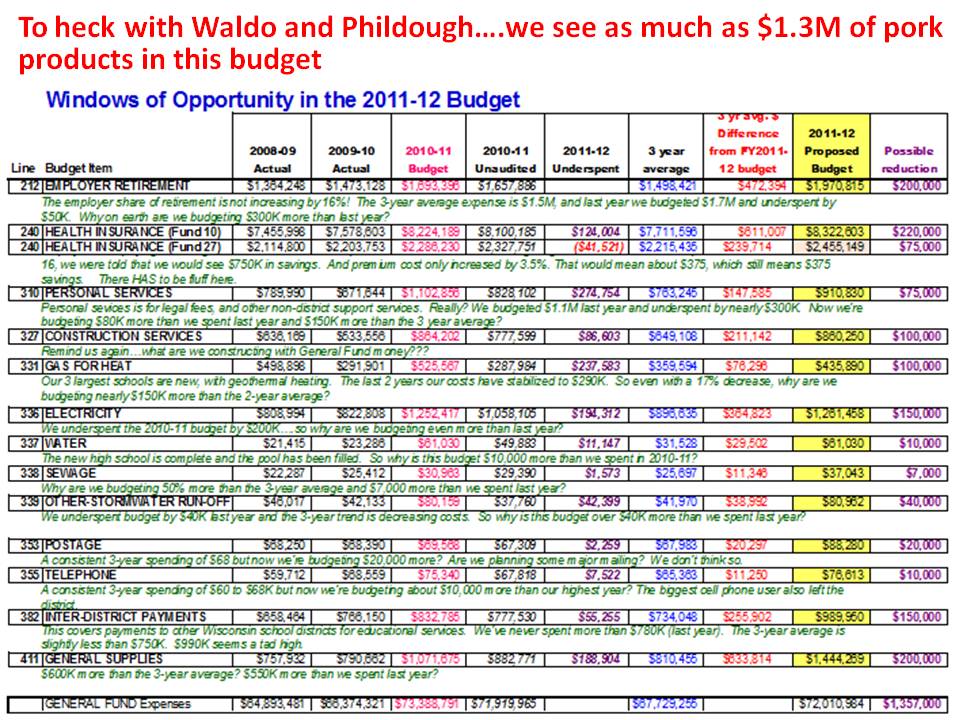
2011-12 Budget Pork - The Whole 9 Yards

It's getting time to fish or cut bait. We've taken a good hard look at the proposed/draft 2011-12 SPASD budget, and we find a number of budget lines to be potentially low hanging fruit...ripe for the pickin'.

Download a PDF copy of SP-EYE Analysis of the 2011-12 SPASD Budget  
 Maybe we don't have it right...we can admit it when we make an error...but it places the burden of proof squarely upon the district. PROVE to the community that you absolutely need all that is budgeted, and you have our support.

 Otherwise...get your pencils sharpened. We believe quite strongly that we can fund at least the first two initiatives recommended by the district, and still get the tax levy increase down to 2.5% or less.


Pork Also Found in the Fund 27 Budget; Film At 11

Many of you will initially ask, "What's Fund 27?  I thought there was just Fund 10, the General Fund"?
Well, boys and girls, Fund 27 is the Special Education budget for each school district.

OK, you're gasping...aren't you?  Just like no one expects the Spanish inquisition, no one pokes the sacred cow.   Right?  Wrong! Stop being a bunch of namby pambies.  These are YOUR tax dollars.  The district is sure to quickly come to the defense of special education, adding a smoke screen to what we really want you to see.  Get off it!  Nobody is attacking Special Education.  We understand and value the services provided for our special needs children.  So let's just nip that one in the bud, eh?   We only want to look at ONE part of the budget.  So let's all be adult about it.

12.5% of the General Fund goes to fund Special Ed
The district is quick to gloss over the "other" funds, like Food Service and Special Education, by declaring that the district tax levy comes only from the General Fund (Fund 10).  But what we cannot lose sight of the simple fact that the district transfers over $9,000,000 dollars into the Special Ed fund (Fund 27) annually.  That amounts to 12.5% of the General Fund.  Nothing to sneeze at!

So if we're not off poking the sacred cow, what's our point?  The point is that just like the regular education budget, the special ed budget includes specific line item costs for staff salaries, and fringes...including health insurance!  So...if we're looking at--and finding budgetary fluff--in the health insurance line of Fund 10, we also have to look at that line item in Fund 27.  After all, Fund 10 provides 70% of the entire revenue needs for Fund 27.

Then why the two orders? Colonel?
Why is it that for the general fund, the budget document shows a 1.20% increase for health insurance, but for the Special Education budget, it shows a 7.39% increase for 2011-12???  Employees DO pay the same share of their health insurance costs regardless of which program they belong too, right?

What's the bottom line
The total proposed budget for health insurance in the General Fund is $8.3M...and we believe there to be at least $220,000 excess in that.  Therefore, with a Special Ed health insurance budgeted mount of $2.45M, don't tell us that there's not at least $75,000 extra in there as well.